

WordWhizzle Connect
Apprope AB
I went into WordWhizzle Connect expecting a light word puzzle for filling a few spare minutes, and that is still the best way to understand it. This is a free word game from Apprope AB, built around the simple pleasure of spotting connections between letters and turning a small clue into a satisfying answer. It does not ask me to learn a complicated rule set before playing. I can begin quickly, make a guess, see how the game responds, and decide almost immediately whether I want another round.
That simplicity is its strongest quality, but it also sets a clear limit. This is not the right choice if I want a large adventure, a deep competitive system, or a long story to follow. It is better suited to short, repeatable sessions in which the thinking itself is the entertainment. After spending time with it, I found that the most useful question is not whether it is “fun” in the abstract, but whether its action, feedback, reward, and restart rhythm fits the way you like to play.
How the word-solving loop feels in practice
The first action is easy to understand
The appeal begins with a low barrier to entry. I do not have to memorize a complicated control scheme or manage several systems at once. The central task is word-based, so my attention goes toward recognizing possibilities, testing a connection, and deciding whether a word fits. That makes the opening moments comfortable for people who enjoy spelling, vocabulary, pattern recognition, or quiet logic puzzles.
What I like is that the game leaves room for a natural first attempt. I can look at the available information, form an idea, and act without feeling that I am navigating menus instead of playing. That matters in a mobile word game because the best sessions often happen unexpectedly: while waiting for an appointment, during a short break, or when I want something more engaging than scrolling but less demanding than a full game.
The format also makes it approachable for mixed-age households. Its content rating is Everyone, and the basic concept is understandable without specialist knowledge. A younger player may approach it as a vocabulary challenge, while an adult may enjoy the same puzzle as a quick mental reset. The difference is that experienced word-game players may move through familiar patterns faster and start wanting more variety or a tougher challenge.
Related News






One practical tip helped me enjoy the opening more: I stopped treating every first guess as a test of vocabulary. Instead, I used it as information. A possible answer can reveal how the puzzle is organized, which letters or relationships matter, and whether my first interpretation is too narrow. That mindset reduces frustration and makes the early action feel exploratory rather than like a pass-or-fail exam.
Feedback gives each attempt a purpose
A word puzzle needs clear feedback because the player is constantly asking, “Was that the right direction?” WordWhizzle Connect works best when I pay attention to that immediate response instead of rushing through guesses. A successful answer provides a small burst of confirmation, while an unsuccessful attempt encourages me to reconsider the connection rather than simply repeat the same thought.
This creates a useful rhythm: observe, connect, submit, react, and adjust. The rhythm is not dramatic, but it is dependable. I never need a large animation or a complicated reward screen to understand whether I am making progress. The satisfaction comes from seeing an idea become a valid solution and from noticing that the next puzzle may require a slightly different way of looking at words.
Gallery
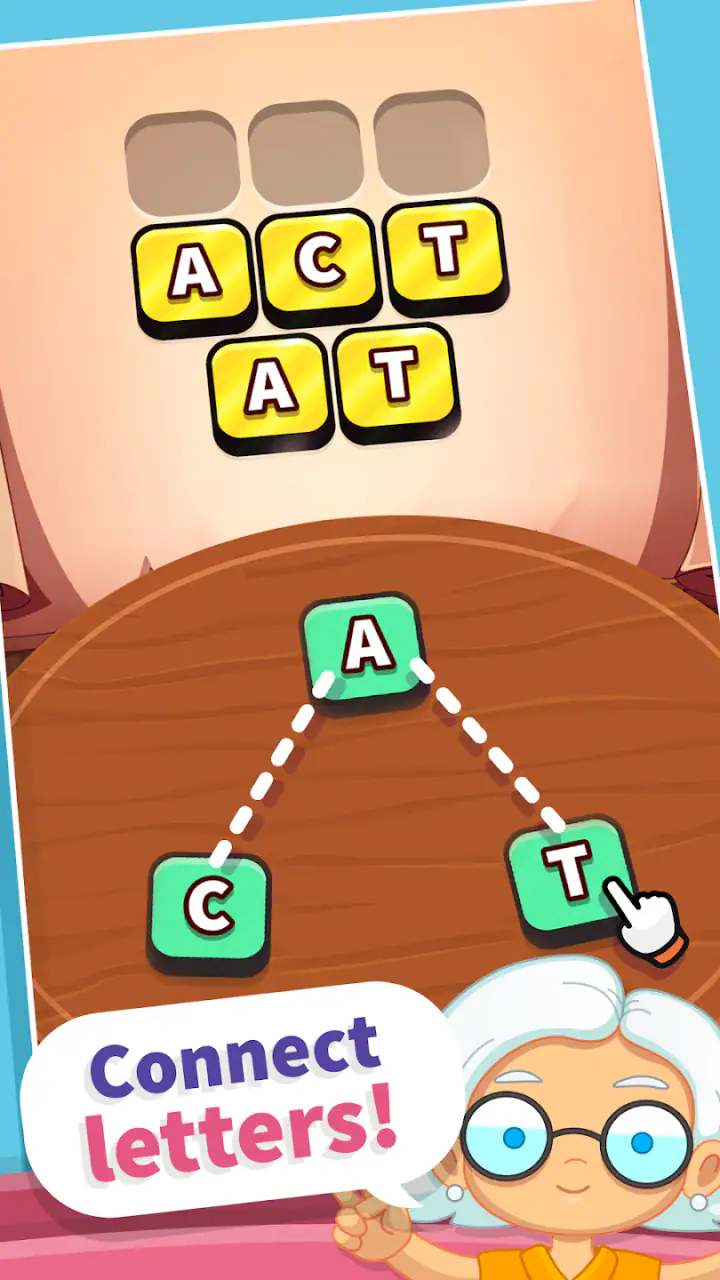
That rhythm is especially good for players who enjoy deliberate solving. I found myself moving between two modes. At first I searched for the obvious relationship, then I switched to elimination when the first idea did not work. That small change in approach is where much of the mental value lies. The game can make a short session feel active without requiring fast reactions, which gives it an advantage over word games built mainly around timers or rapid tapping.
There is also a trade-off here. Because the loop is focused, a wrong answer can feel more noticeable than it would in a larger game with many distractions. If I became fixed on one interpretation, the simplicity that made the puzzle accessible could also make the barrier feel stubborn. The best response was to pause, reread what was in front of me, and look for a broader association rather than forcing the first promising word.
For that reason, I would not recommend playing every puzzle at maximum speed. A slower first pass often saves time. I tried identifying the strongest connection, checking whether it matched the whole prompt or structure, and only then committing. This is a small habit, but it turns the game from random guessing into a more controlled process.
The reward is the solved idea, not a complicated economy
The most convincing reward in this game is the moment a difficult connection finally makes sense. I enjoy that kind of payoff because it comes directly from my own reasoning. The game does not need to bury the result under a long progression system for the answer to feel worthwhile. Solving a puzzle gives me a clean sense of completion, and that is enough to make the next challenge attractive.
That design makes the title easy to pick up when I want a small mental workout. I can play because I have a few minutes, but I can also play because I want to test how quickly I can recognize a pattern. The reward is flexible: sometimes it is the answer itself, sometimes it is the relief of escaping a stubborn puzzle, and sometimes it is simply the feeling that my attention has been used for something more satisfying than passive entertainment.
Players should also understand the difference between this kind of reward and the reward structure of a large free-to-play game. The emphasis here is on solving, not on building a character, collecting equipment, or advancing through a story. If you need constant unlocks, social competition, or visible long-term progression to stay interested, the central word-solving payoff may not be enough on its own.
The free price makes it easy to try without committing money at the start. There are optional in-app purchases ranging from $0.99 to $49.99 per item, so I would approach those carefully and decide in advance whether the basic experience already meets my needs. For a casual player, the sensible starting point is to spend time with the free version first. The puzzle loop should earn your interest before you consider any optional purchase.
That advice is more important for word games than it may seem. A purchase can remove a moment of friction, but it cannot replace the satisfaction of recognizing the answer yourself. If the challenge is the reason you opened the game, I would avoid using assistance too quickly. I found that sitting with a difficult clue for another minute often produced a better reward than bypassing the problem immediately.
Why another session begins after the reward
Once I solve a puzzle, the game has a straightforward choice: let the moment end or offer a reason to continue. WordWhizzle Connect benefits from the second option because its challenges are naturally bite-sized. A completed answer closes one small mental task, but it also leaves me curious about whether the next connection will be obvious, tricky, or based on a different kind of word relationship.
This is where the game’s repeatability becomes clear. I do not need to prepare for a long campaign. I can finish a short session after one puzzle, or continue when I have more time. That flexibility makes it useful in everyday situations. For example, I could open it while waiting for a friend who is a few minutes late, solve a puzzle, and put the phone away without losing the evening to a much larger game. If I am at home and in the mood to concentrate, I can use the same starting point for a longer run.
The reset is also mentally clean. There is no need to remember a complicated plot or rebuild a strategy from an earlier session. I simply face a new word problem and begin the observation process again. That makes the game particularly suitable for irregular players who may return after a day or a week and want to start immediately rather than study what happened last time.
At the same time, this reset can expose the game’s main weakness. Players who want a strong sense of destination may feel that one solved puzzle leads only to another puzzle. The loop is intentionally circular: action leads to feedback, feedback leads to a solution, the solution leads to a fresh challenge, and the cycle starts again. I find that satisfying in short bursts, but I can also see it becoming repetitive for someone who prefers a campaign with changing objectives.
My practical approach is to use the reset as a stopping point instead of treating it as a demand to keep playing. When I notice that I am guessing mechanically, I end the session. Because the game is easy to return to, there is little benefit in pushing through while distracted. This preserves the enjoyable part of the loop and prevents a relaxing puzzle from turning into a chore.
Where it fits among other word games
Compared with a crossword, WordWhizzle Connect feels more immediate. A traditional crossword can offer a broad grid, intersecting answers, and a larger sense of construction. That is rewarding when I want a substantial puzzle to work through, but it can require more time and commitment. This game is a better fit when I want the word connection itself without settling in for a full page of clues.
Compared with a daily word-guessing game, it has a different kind of appeal. Daily formats create a shared routine and a clear limit, while this title is more naturally suited to repeated short sessions. I do not open it only because a new daily puzzle has arrived; I open it because I have the attention for another small challenge. That makes it more flexible, although it may lack the ritual and social conversation that make daily games so compelling.
It also differs from fast word searches and timed anagram games. Those alternatives reward speed, visual scanning, and quick recall. WordWhizzle Connect is more comfortable for me when I want to think rather than race. If your favorite part of a word game is beating a clock, you may find this experience too measured. If you prefer finding a relationship and confirming that it works, its calmer pace is a strength.
One non-obvious advantage is that the game can work as a transition activity. I used it as a bridge between tasks: long enough to wake up my attention, but contained enough that I could stop. That is different from opening a social feed, where the stopping point is unclear, and different from starting a large game, where even a short session can feel incomplete. The word puzzle gives me a defined mental task with a natural endpoint.
Who will enjoy it, and who should skip it
I would recommend this game to people who like vocabulary challenges, pattern recognition, and self-paced mobile play. It is a good match for commuters, students taking a short break, adults who enjoy keeping their minds active, and anyone who wants a free word game that can be understood quickly. Families may also appreciate the Everyone rating and the absence of a complicated premise.
I would be more cautious about recommending it to players who need rich visuals, narrative development, multiplayer interaction, or a strong collection system. It is also not the ideal choice for someone who dislikes uncertainty in word puzzles. Even a simple connection can feel subjective until the game confirms it, and that moment of testing is part of the experience rather than an inconvenience that disappears entirely.
Another group that may prefer an alternative is the serious crossword enthusiast. If you want layered clues, intersecting answers, and a puzzle that can occupy a long quiet afternoon, a full crossword app will probably offer more depth. Likewise, someone focused on language study may prefer an app with explicit definitions, pronunciation practice, or structured lessons. This game can exercise recognition and recall, but I would not use it as a replacement for a dedicated learning course.
Technical details worth knowing before installing
WordWhizzle Connect is available as a free game, and its current version is 1.6.6. It requires Android 7.0 or later, so owners of older devices should check compatibility before planning around it. The game has passed the stage of being an obscure experiment: it has more than one hundred thousand installs, an average rating of 4.6 from around eight thousand seven hundred ratings, and approximately two thousand four hundred written reviews.
Those figures suggest that the basic idea has found a real audience, but I would not treat popularity as proof that every player will enjoy the same loop. Ratings are most useful here as a sign that the accessible word-puzzle format works for many people. My own recommendation still depends on your preferred pace. The game’s strengths are clarity, portability, and repeatable solving; its limitations are the narrow focus and the possibility of repetition.
The release date of August 21, 2017, also places it in the category of an established mobile title rather than a brand-new launch. That can be reassuring if you want something with a recognizable history, though it also means I would not expect the novelty of a freshly introduced format to carry the experience. The important question is whether the core loop remains enjoyable after the first few sessions, and for me it does, provided I play it in short, intentional bursts.
Apprope AB keeps the identity of the game focused on words rather than turning it into a general-purpose entertainment hub. That focus is helpful when I want to open an app with a specific purpose. I know I am going there to solve, receive feedback, enjoy the answer, and decide whether to reset into another puzzle. The lack of extra layers is both the reason it is approachable and the reason some players will eventually look elsewhere.
My verdict on the complete loop
The action is quick to understand, the feedback gives each guess meaning, and the reward comes from solving rather than from decorative progression. After that, the reset is almost effortless: a completed puzzle becomes an invitation to test another connection. That sequence is the heart of the experience, and it explains why I can return to it even when I do not have enough time for a larger game.
My main advice is to treat WordWhizzle Connect as a focused pocket puzzle, not as an all-purpose word platform. Start with the free experience, take time to examine a stubborn connection, and resist turning every session into a race. If you enjoy the answer more than the surrounding systems, this is a pleasant and accessible choice. If you need a story, competition, deep progression, or formal language instruction, another category of app will serve you better.
For my part, I would recommend it to a friend who wants a simple way to make spare minutes feel more active. It is not ambitious, but it understands the value of a clean loop: I try an idea, learn from the response, enjoy the small win, and choose whether to begin again. That focused rhythm is the real reason to install it.
FAQs for WordWhizzle Connect
What is WordWhizzle Connect and how does the game work?
WordWhizzle Connect is a word puzzle game in which you connect letters to create words and solve themed challenges. During my review, the basic controls felt simple to understand: swipe across neighboring letters to form a word, then release to submit it. Each puzzle encourages you to find the required answers, while extra words may help improve your score or reveal additional progress.
Is WordWhizzle Connect free to download and play?
WordWhizzle Connect can generally be downloaded and played for free, making it easy to try without paying upfront. However, the game may include optional in-app purchases for hints, coins, or other helpful resources. Progress is possible without spending money, although players who use hints frequently may encounter limits and advertisements as they continue through the puzzles.
Does WordWhizzle Connect require an internet connection?
The game’s availability without an internet connection can depend on the version installed and the feature you are using. Basic puzzle gameplay may work offline in some situations, but advertisements, purchases, updates, synchronization, and certain online features usually require access to the internet. If offline play is important to you, test a few levels after installation rather than assuming every feature will work.
Is WordWhizzle Connect suitable for children and beginners?
WordWhizzle Connect is approachable for beginners because its swipe-based controls are straightforward and the early puzzles usually provide a gentle introduction to the mechanics. It can also be useful for players who enjoy vocabulary practice. Difficulty may increase over time, and younger children could need help with less familiar words. Parents should also review advertising and in-app purchase settings.
What are the main advantages and disadvantages of WordWhizzle Connect?
The main advantages are its quick gameplay, simple letter-connecting controls, themed word challenges, and the ability to play a few puzzles whenever you have spare time. It is a good choice for casual players who enjoy vocabulary games. On the other hand, repeated advertisements, limited hints, increasingly difficult word combinations, and optional purchases may reduce the experience for players who prefer uninterrupted or completely unrestricted gameplay.
Pros
- Quick word puzzles are ideal for short breaks.
- Simple controls make it accessible for most players.
- Increasing difficulty keeps the challenge engaging.
- Offline play is useful when no internet is available.
- Frequent level variety helps prevent repetitive gameplay.
Cons
- Some levels rely on obscure or uncommon words.
- Hints may be limited unless you watch ads or pay.
- Repeated puzzles can feel predictable over time.
- Small text may be uncomfortable on compact screens.
- Progress can feel slow after the early levels.


